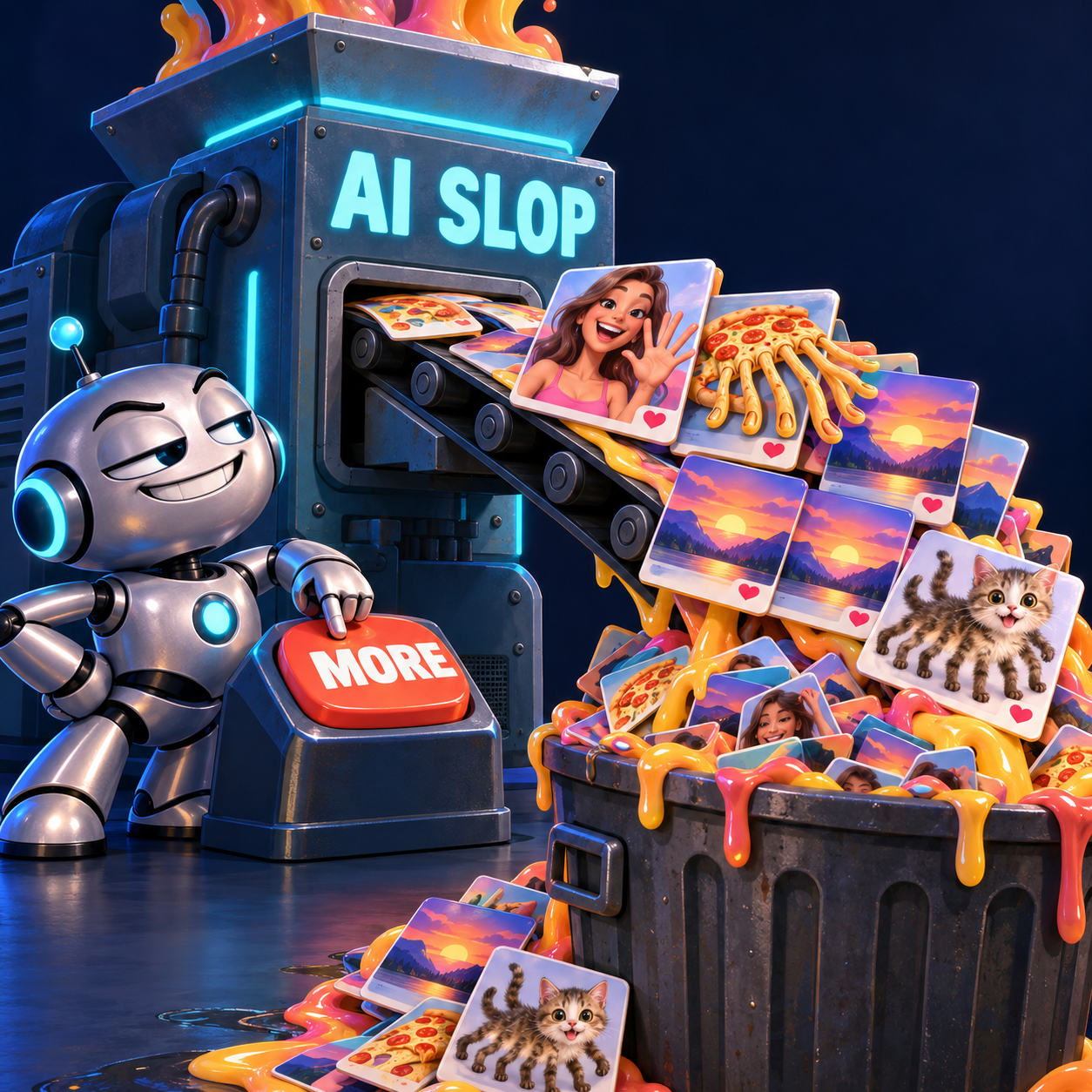
It’s stealing jobs. It’s saving the world. It’s going to replace every artist and musician alive. And depending on who you ask, the fact that it occasionally draws six fingers on a hand is either proof that it’s harmless or proof that civilization is doomed.
So what are you doing with it?
And I don’t mean, “What did you ask ChatGPT to make for dinner?”
I don’t mean generating a picture of yourself as a vampire queen either. Although, sure. Live your truth.
I mean: Have you tried building something real?
Because every time people talk about AI online, the conversation gets flattened down to chatbots and weird pictures. And honestly, that’s maybe ten percent of what’s interesting about this technology right now.
You can build a website without knowing HTML.
You can put together a working app without knowing how to code.
There’s probably some annoying task you do every single week that eats an hour of your Sunday and makes you want to throw your laptop across the room. You can probably automate at least part of it.
You can turn a weekend’s worth of research into twenty minutes.
You can build some dumb little tool that only makes sense to you, a tracker, a planner, a calculator, a database for the one strangely specific thing in your life that apparently requires its own system.
And you don’t have to become a software engineer first.
That’s kind of the whole point.
I keep thinking about how many good ideas quietly die because of one sentence:
“I wish there was an app for this, but I can’t code.”
“I’ve always wanted a website, but I don’t understand any of that stuff.”
“I can hear the song in my head, but I have no idea how to actually produce it.”
Those ideas didn’t necessarily die because they were bad.
They died because the person who had them wasn’t also a programmer, designer, developer, producer, editor, marketer, and whatever else the idea demanded that week.
That’s a pretty dumb reason for a good idea to disappear.

Now, I want to be careful here because AI hasn’t magically removed every barrier.
You still need judgment, taste, and patience.
And you still need the willingness to stare at something broken for twenty minutes wondering why the stupid button refuses to move three pixels to the left.
But the wall between “I have an idea” and “let’s see if this actually works” has gotten a lot thinner.
And that changes what’s worth trying.
Most ideas never even get tested.
They die in the I don’t know how stage before anyone ever finds out whether they were good.
I’d rather find out.
Maybe the app is a terrible idea.
Maybe the website looks ridiculous.
Maybe the song sounds much better in your head than it does coming through a pair of speakers.
But at least now you know.
That’s still further than the idea ever got sitting in a notebook, buried in a folder, or floating around your brain for the last five years.
And that’s really what I want this whole series to be about going forward.
Not whether AI is good or evil in the abstract.
Not another argument about whether robots are coming for civilization.
I want to talk about what regular people can actually make with it.
Not engineers.
Not Silicon Valley founders.
And definitely not the guy posting Lamborghini screenshots underneath a thread about “passive income.”
Regular people.
People with ideas.
People who don’t know how to code.
People who aren’t designers.
People who have never produced music, built an app, created a website, automated a business process, or made anything remotely technical before.
Because now you can at least try.
So here’s the question:
What have you been putting off because you assumed you didn’t have the skills to do it?
I’m starting to wonder how often the skills were really the blocker.
Might be worth testing that theory.
And yes, AI helped me write this post.
So sue me…
Keep up with
The AI Companion Guide.